Office chair review
Herman Miller Aeron Review — Why It's Still the Benchmark After Three Decades
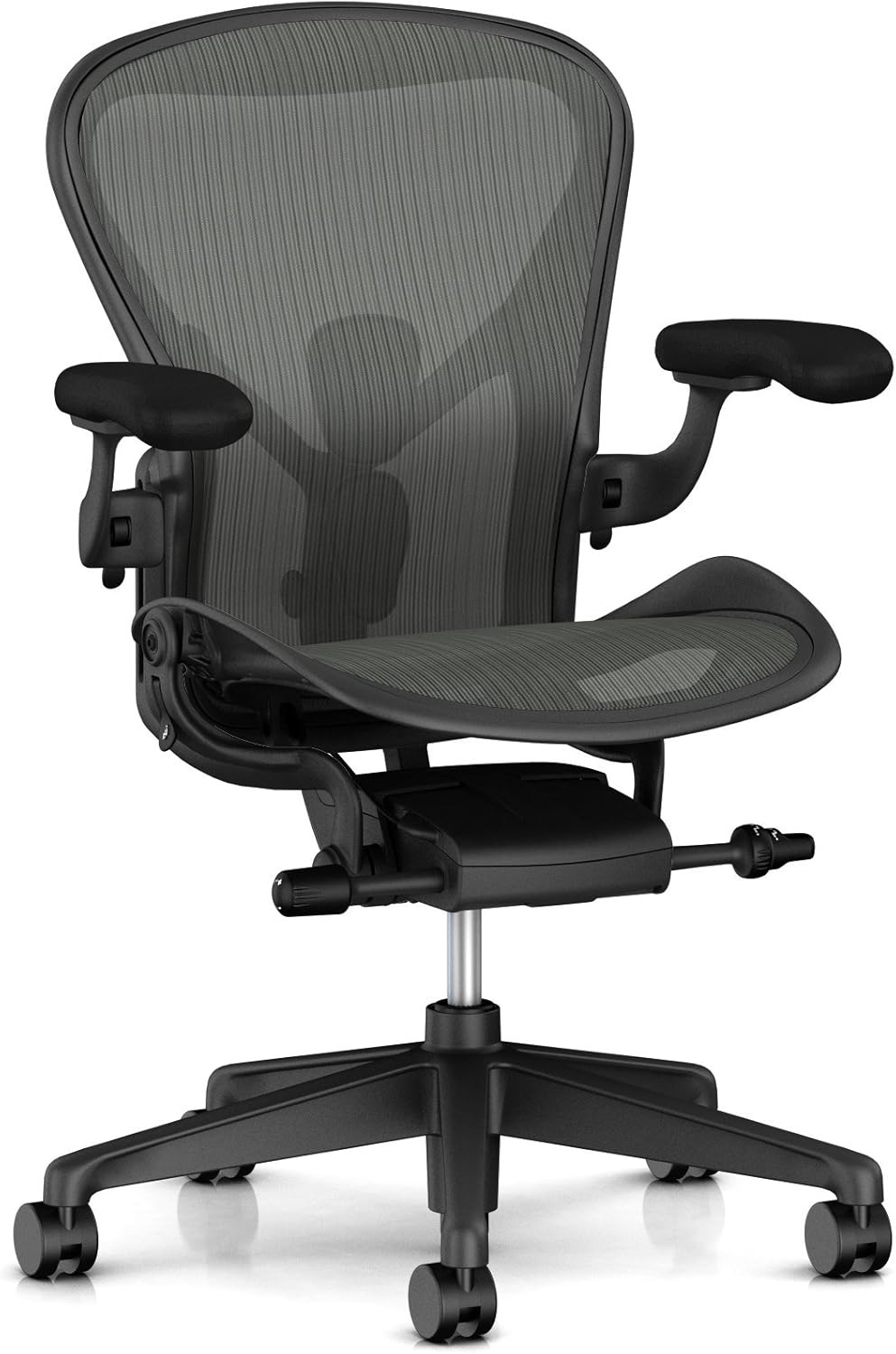
Herman Miller Aeron Chair — manufacturer/retailer product photo.
Listen to the verdict
Verdict
The benchmark ergonomic chair. Expensive on day one — but with a 12-year warranty and a resale market that holds 60–70% of new value, the long-run depreciation works out to roughly the same as a mid-tier chair you'd actually want. Its closest rival for tall users and bad backs is the Steelcase Leap V2; see both head-to-head in our best office chair under €1500 guide.
What works
- PostureFit SL — two-zone active lumbar that moves with your spine
- Pellicle mesh — breathes in any climate, no sweat patches in summer
- 12-year warranty covering 24/7 use
- Tilt, recline, armrests, lumbar all adjust independently
- Three sizes (A / B / C) — the chair fits the person
- Resale market holds 60–70% of new value
What doesn't
- €1,400 is the same as a second-hand car
- Sized A / B / C — pick wrong and the experience is ruined
- Fully-loaded options (PostureFit SL + 4-way arms) add 30–50%
- Mesh seat firms up over years (replaceable but not free)
Why every other chair is measured against this one
Herman Miller introduced the Aeron in 1994. It was the first mass-market office chair built on the premise that the chair should adapt to the body, not the other way around. The original spec sheet — mesh seat instead of foam, articulated armrests, three sizes for different body types, lumbar support that moved with the spine — defined what "ergonomic chair" came to mean for the next 30 years.
The Aeron has been redesigned once, in 2016 (the "Remastered" model). The geometry, posture system, and warranty are essentially unchanged. That tells you the original was right. Every premium chair sold since — Steelcase Leap, Aeron's own Embody and Sayl, the dozens of "ergonomic" knockoffs on Amazon — is measured against this one, explicitly or otherwise.
Watch before you buy
Official Herman Miller
Official Herman Miller Aeron adjustment video — covers PostureFit SL, forward tilt and arm angle adjustments you need to dial in for back support.
PostureFit SL — the lumbar support that earned the name
The chair you sat in for the first year of your career had a lump of plastic glued to the backrest labelled "lumbar support". The Aeron has PostureFit SL — two independent pads that support the sacrum (lower) and lumbar (mid-back) zones separately. Both are adjustable for tension. Both move with you when you recline.
The "SL" stands for sacral-lumbar — Herman Miller's terminology for the dual-zone approach. Steelcase and Humanscale have their own equivalents now, but the Aeron was the first chair to argue that the lower spine and the mid-spine need different things from a chair, and to actually engineer for it.
The 12-year warranty
Herman Miller warrants the Aeron for 12 years of 24/7 use. That's 105,120 hours — for most desk workers, roughly 20–25 years of normal weekday use. The competitive landscape:
- IKEA Markus: 10 years (with fine print on covers and cushions)
- Steelcase Leap V2: 12 years
- Generic Amazon "executive" chair: 1–2 years
- "ErgoChair" knockoffs: typically 1 year, often voided by use
The reason the length matters is what it signals: a company willing to underwrite a chair for 12 years of round-the-clock use is making a costly bet on its own build quality. A one-year warranty on a €200 chair is making the opposite bet.
Who it's for vs the cheaper alternatives
If you sit at a desk four hours a day or less, you don't need an Aeron. A €200 IKEA Markus, an HÅG Capisco, or a refurbished mid-tier chair gets you 90% of the experience for 15% of the price.
The Aeron earns its premium for one specific user: the person who sits 8+ hours a day, every weekday, for years. At that frequency, the math changes. You're not buying a chair — you're buying 25,000+ hours of seated time. The €1,400 / 25,000 = €0.056 per hour. The €200 chair, replaced every two years over the same span, costs about the same and gives you a worse spine.
Genuine alternatives worth considering at lower price points:
- HÅG Capisco (~€800) — Norwegian-made, designed for active sitting and standing-desk pairing. Different philosophy from the Aeron but a real competitor.
- Steelcase Series 1 (~€500) — younger sibling of the Leap. Cuts the right corners. Still on the same warranty system.
- Used Aeron — see the next section.
Resale value — the part that flips the math
This is the section nobody writes about because it's the section that argues with itself. The Aeron resale market is real, active, and surprisingly forgiving. A used Aeron in good condition (5–10 years old, mesh intact, no visible damage) sells on eBay, Marktplaats, and office liquidators at 60–70% of new retail.
Two practical implications:
- Buying new: if you decide within 30 days that it's not for you, sell it and you're out maybe €100 (shipping + listing). At one year out, maybe €300–500. Compare to the depreciation curve of a €200 chair — which you'll throw out, because nobody pays €60 for a used office chair without a brand on it.
- Buying used: the real entry point is the second-hand market. €600–800 gets you a 5-year-old Remastered Aeron with most of its useful life remaining and 5+ years of warranty still on the clock. This is the path most people end up taking.
The cost-per-hour math, properly run, looks more like €0.04–0.06/hour for the Aeron — and that's the same band as a Steelcase Leap or a HÅG Capisco. The €1,400 sticker is misleading because it implies the chair will become worthless. It won't.
Sizing matters more than colour
The Aeron comes in three sizes — A (small), B (medium, the most popular by a wide margin), C (large). They differ in seat width, seat depth, and back height. Pick the wrong size and the chair becomes uncomfortable instead of corrective.
Herman Miller publishes a sizing chart based on height and weight. Use it. If you're between sizes, bias toward the larger one — the postural fit is more forgiving when you have slightly more chair than you need, less so when you have less. Buying used, the listing should specify size; if it doesn't, ask.
One thing the spec sheet won't tell you
A chair this comfortable removes the physical cue that tells you to stand up. That is good for output and questionable for your back over a decade. If you don't already have a movement habit, no chair will give you one — build it separately, whatever you end up sitting in.