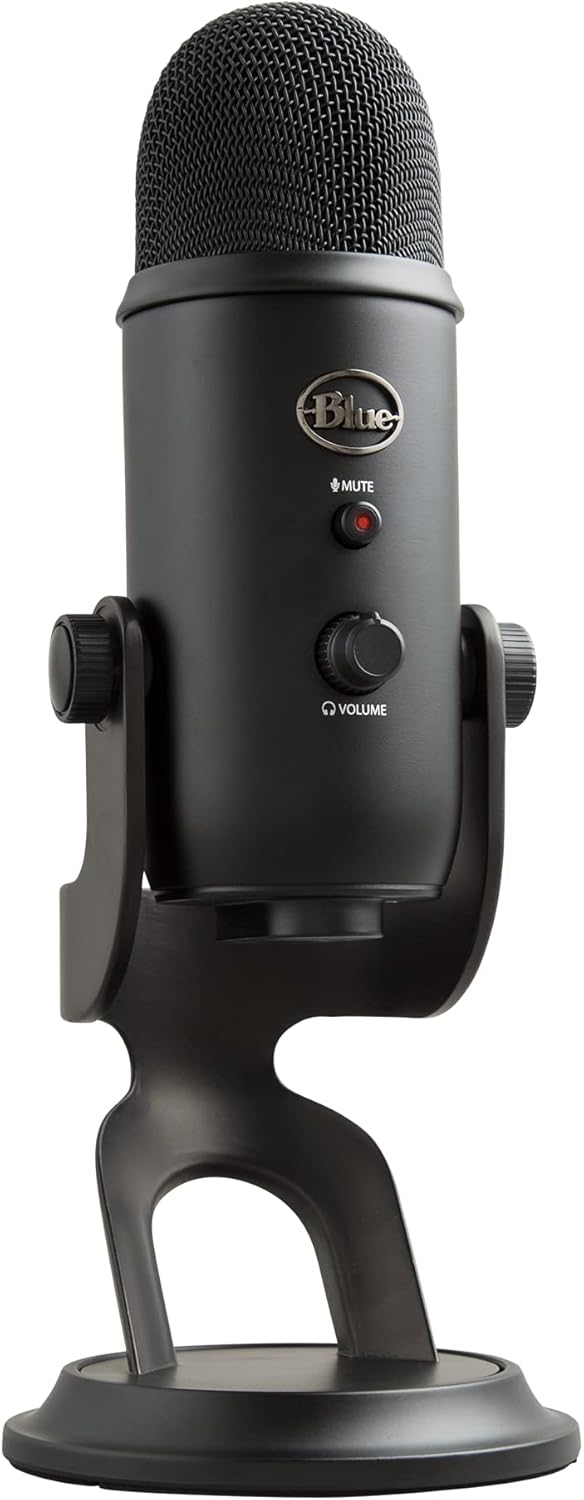
Blue Yeti USB Microphone — manufacturer/retailer product photo.
FutureFavs Review
The Blue Yeti remains the gold standard USB microphone for podcasters, streamers, and remote workers in 2026.
Blue Yeti USB Microphone — manufacturer/retailer product photo.
Listen to the verdict
The Blue Yeti remains one of the best-regarded combinations of versatility, audio quality, and ease of use at the €129 price point. Its four polar patterns make it unique in the consumer USB mic space — no other mic under €150 lets you switch from cardioid podcast recording to omnidirectional roundtable capture with a single knob turn. The trade-off is size and weight: at 1.2 kg on its included stand, this is a desk microphone, not a travel companion. For how it stacks up against the dynamic and compact-condenser alternatives, see our best USB microphone for podcasting in 2026 roundup.
Buy on Amazon →MKBHD on the Blue Yeti
Marques Brownlee featuring the Blue Yeti in his YouTube gear series. It remains our top USB-condenser pick under €150.
| Feature | Blue Yeti USB Microphone | Alt 1 | Alt 2 |
|---|---|---|---|
| Price | €129 | €249 (Shure MV7) | €99 (Rode NT-USB Mini) |
| Polar Patterns | 4 (cardioid, bi, omni, stereo) | 1 (cardioid) | 1 (cardioid) |
| Connection | USB (Mini-USB) | USB + XLR | USB-C |
| Frequency Response | 20 Hz–20 kHz | 50 Hz–16 kHz | 20 Hz–20 kHz |
| Self-Noise | <20 dBA | ~20 dBA | 18 dBA |
| Headphone Monitor | Yes (3.5mm, zero-latency) | Yes (3.5mm) | Yes (3.5mm) |
| Weight | 1.2 kg (with stand) | 0.55 kg (body only) | 0.32 kg |
| XLR Upgrade Path | No | Yes | No |
| Noise Rejection | Good (condenser) | Excellent (dynamic) | Very Good (condenser) |
| Sample Rate | 48 kHz / 16-bit | 48 kHz / 24-bit | 48 kHz / 24-bit |
The Blue Yeti's secret weapon is its three custom condenser capsules arranged in a proprietary array. Unlike single-capsule USB microphones, the Yeti can blend signals from different capsule orientations to achieve four distinct polar patterns. In cardioid mode (the default), it picks up a heart-shaped zone directly in front of the microphone — ideal for solo podcasting, voiceovers, and gaming streams. Bidirectional mode captures sound from front and back while rejecting the sides, perfect for two-person interviews across a single desk. Omnidirectional captures all 360° equally, making it the best mode for recording meetings, roundtable discussions, or room ambience. Stereo mode uses left and right capsules independently to create a true stereo image — useful for acoustic instruments or ASMR content.
The practical upshot: one microphone covers every recording scenario you're likely to encounter. Most USB microphones at this price are cardioid-only. The Yeti's pattern switching is why it has remained the top recommendation on every major creator platform for over a decade.
The Yeti records at 48 kHz / 16-bit, which is the standard for podcast and streaming distribution. The frequency response is rated 20 Hz–20 kHz, and in practice the low-end warmth is the Yeti's signature characteristic — voices sound full and broadcast-quality without heavy EQ processing. The self-noise is rated at less than 20 dBA, which is acceptable for spoken word but shows its age compared to the Rode NT-USB Mini's 18 dBA or the Shure MV7's 20 dBA with better proximity effect.
Background noise rejection in cardioid mode is solid as long as you use proper technique — speaking 15–20 cm from the capsule at 45–90° off-axis reduces plosives significantly. The included stand places the capsule at about 15 cm off the desk, which is too low for most users; investing in a boom arm (we recommend the Rode PSA1 at €99 or the Elgato Wave Low Profile at €35) transforms the recording quality by getting the mic to mouth level.
The built-in headphone amplifier is clean and drives most headphones to listening volume without distortion. Latency on the monitor output is genuinely zero — the signal is taken directly from the capsule before any digital processing, which is critical for vocalists and narrators who find even 5ms of latency distracting.
The Blue Yeti is constructed from zinc alloy — the same material as high-end camera bodies. It feels premium and resists the flex and creak you get from plastic-bodied competitors. The mute button has a satisfying tactile click and an LED ring that glows red when muted, visible from across a streaming setup. The gain knob is smooth with enough resistance to prevent accidental adjustment.
The included stand is adjustable in angle but fixed in height. It works, but it positions the microphone roughly 8–10 cm above the desk surface — fine for typing capture but too low for clean vocal recording. Blue sells a dedicated shock mount (€49) and a boom arm (€79), but third-party alternatives cost less. The Yeti's 5/8-inch thread is compatible with most professional boom arms.
One note on the USB connection: the Yeti uses a Mini-USB port (not USB-C), which is a legacy design decision that shows the product's age. The cable is included and works reliably, but a USB-C version would be welcome at this price point in 2026.
Plug in the USB cable and the Yeti is immediately recognized as an audio device on macOS and Windows — no driver installation required. The Blue Sherpa software (now part of the Blue VO!CE suite, available for free) adds real-time voice effects, noise suppression, and EQ presets. It is optional; the microphone works perfectly without it.
Blue VO!CE includes a broadcast preset that adds subtle high-pass filtering and presence boost to make voices sound more radio-ready. The noise suppression algorithm is effective at cutting HVAC hum and keyboard clatter, though it introduces a slight metallic quality on speech that purists will notice. For most streaming and podcast applications, the default cardioid mode with the broadcast preset is the fastest path to professional-sounding audio.
OBS Studio, Adobe Audition, GarageBand, and every major DAW recognize the Yeti as a standard audio interface. Stream Deck users can map the mute button to a profile switch for seamless live switching.
The Blue Yeti is the right choice for: (1) solo podcasters and streamers who want professional audio without an audio interface, (2) remote workers who need a significant upgrade from laptop microphones for video calls, (3) content creators doing voiceovers, gaming commentary, or ASMR who need polar pattern flexibility, and (4) musicians recording acoustic instruments in a home studio context.
It is NOT the right choice for: users who need portability (too large and heavy), users in very loud environments (the condenser capsule picks up more room noise than a dynamic mic like the Shure MV7), or users planning to move to an XLR setup within a year (the Yeti has no XLR output, so upgrading means buying a completely new microphone rather than just adding an interface).
For users primarily concerned with voice isolation in noisy environments, the Shure MV7 (€249) is the better choice — its dynamic capsule rejects background noise significantly better than any condenser mic. For users who want the same Blue Yeti functionality in a smaller form factor, the Blue Yeti Nano (€89) covers cardioid and omnidirectional patterns at lower cost and weight.
Dynamic capsule rejects background noise far better — ideal for loud environments and professional podcasters willing to pay €249.
View on Amazon →Smaller, lighter, USB-C, with lower self-noise at €99 — best compact alternative for travel-conscious creators.
View on Amazon →Anti-clipping technology and Wave Link software make it the top choice for streamers on the OBS/Elgato ecosystem at €149.
View on Amazon →As an Amazon Associate, FutureFavs earns from qualifying purchases. Prices and availability accurate as of publish date.
Now on Kindle · $9.99
The Freelancer's AI Toolkit — 200 ChatGPT prompts for proposals, client emails & invoices.
See the book →