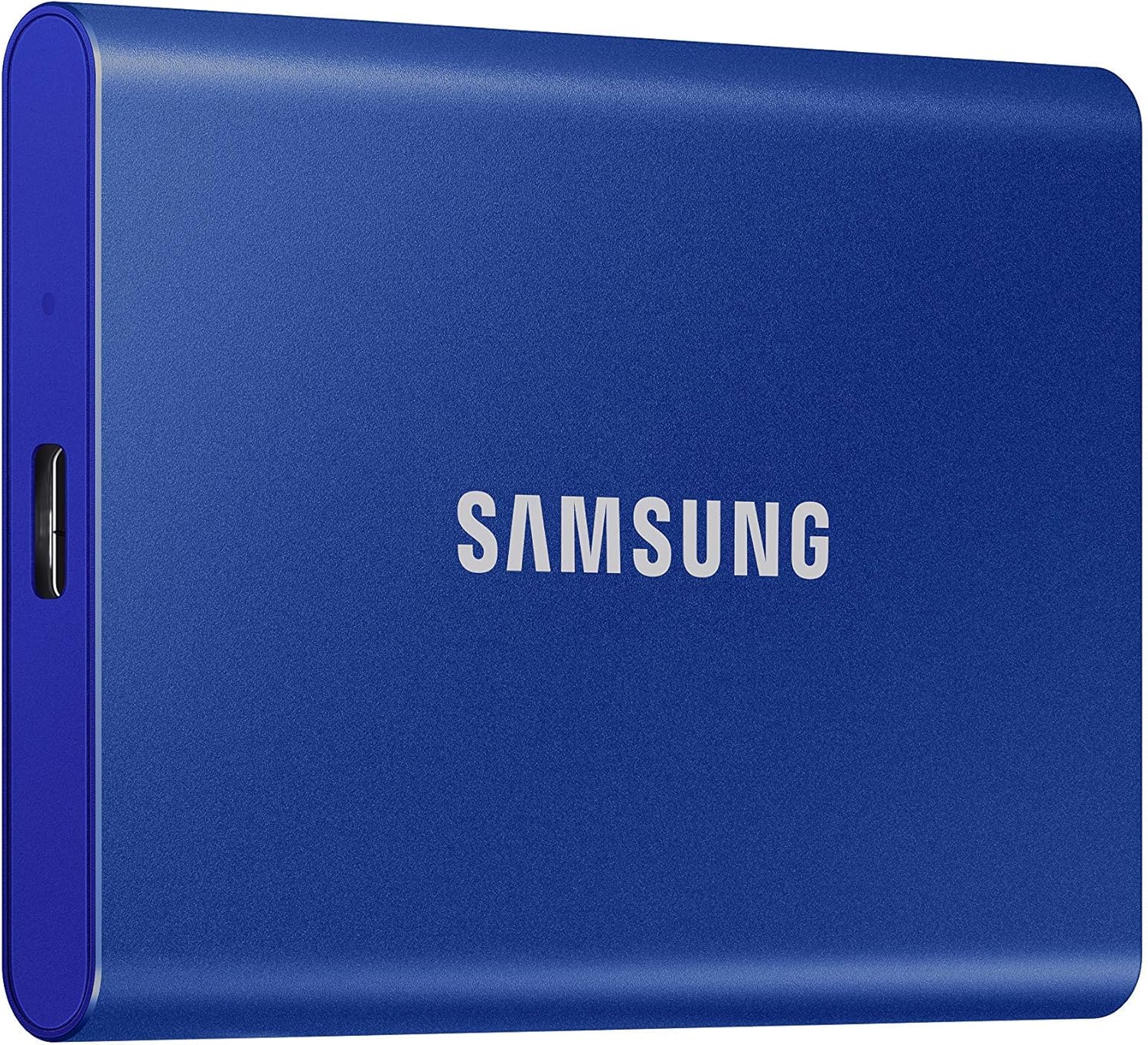
Samsung T7 Portable SSD — manufacturer/retailer product photo.
Listen to the verdict
Quick Verdict
The Samsung T7 is the gold standard for portable SSDs in 2026. Its USB 3.2 Gen 2 interface delivers consistent 1050 MB/s reads and 1000 MB/s writes — fast enough to edit 4K footage directly from the drive. The optional fingerprint-secured T7 Touch variant adds biometric protection without slowing transfers. At €89 for 1TB, there's simply no better value in portable storage. It's a staple in our best Mac productivity accessories roundup, and pairs neatly with a desk dock like the CalDigit TS4 for a single-cable workstation.
Samsung has since released the T9, and for most people it does not change this recommendation. The T9 moves to a USB 3.2 Gen 2x2 interface rated up to 2,000 MB/s — genuinely twice the T7 — but Gen 2x2 ports are rare, and Macs and most laptops top out at 10 Gbps. On those machines the T9 runs at roughly the same 1,050 MB/s as the T7 while costing more. Check what your port actually supports before paying for headroom you cannot use; our full Samsung T9 review works through which machines can reach the higher speed.
It slots into a pocket or laptop bag slot effortlessly at 58g. Whether you're a videographer offloading drone footage on-location, a remote worker carrying a full workspace, or just someone who wants a fast, reliable backup drive — the T7 delivers without compromise.
Watch before you buy
Official Samsung
Official Samsung Portable SSD T7 product video — 1,050MB/s sequential read, AES 256-bit encryption and the durability rating.
USB 3.2 Gen 2: Why the Speed Matters
Most people underestimate how much drive speed affects their actual workflow. The Samsung T7 uses USB 3.2 Gen 2 (10 Gbps), which is a full generation ahead of the USB 3.0 drives that still dominate the portable SSD market. In practice, this means:
Where the speed actually shows up
USB 3.2 Gen 2 tops out at 10 Gbps against USB 3.0's 5 Gbps, and Samsung rates the T7 at 1,050MB/s sequential read and 1,000MB/s write. The gap is felt on large sequential transfers — moving a batch of RAW photos or video rushes — rather than on lots of small files, where per-file overhead dominates and no interface saves you.
Creator note: At Samsung's rated 1,050MB/s, the T7 has the sustained bandwidth to edit 4K timelines directly from the drive rather than copying to internal storage first — unusual for a portable drive at this price.
The NVMe Advantage
Unlike many portable SSDs that use a SATA SSD inside a USB enclosure, the T7 uses Samsung's own NVMe NAND with a USB bridge controller. This architecture is why it maintains consistent speeds even during sustained transfers — it doesn't suffer the dramatic slowdowns you see in cheaper drives once the SLC cache fills up.
Sequential vs. Random Performance
Sequential read: 1,050 MB/s. Sequential write: 1,000 MB/s. Random read (4K QD32): ~350,000 IOPS. These aren't just benchmark numbers — they translate to snappy file navigation, fast app launches if you're running a portable OS, and no waiting when editing directly from the drive.
AES-256 Encryption & Fingerprint Security
The T7 comes in two versions: the standard T7 (password protection only) and the T7 Touch (adds a fingerprint sensor on the body). Both use AES-256 hardware encryption — the same standard used by governments and financial institutions.
T7 Touch: Biometric Access
The T7 Touch's fingerprint sensor unlocks the drive in under a second. You register up to 4 fingerprints, and the authentication happens entirely in hardware — no software, no OS dependency. This makes it genuinely useful for IT professionals, journalists, or anyone carrying sensitive client data.
Important: Hardware encryption means if you forget your password and have no fingerprint registered, the data is unrecoverable. Samsung provides no backdoor. Set up the Samsung Portable SSD app and enable password recovery during initial setup.
Samsung Portable SSD App
The companion app (Windows & macOS) handles password setup, firmware updates, and S.M.A.R.T. health monitoring. It's lightweight and optional — the drive works as a standard USB mass storage device without it, but you'll want it installed at least once for initial password configuration.
Samsung T7 vs. Competitors — Full Comparison
| Drive | Interface | Read Speed | Write Speed | 1TB Price | Encryption | Weight | Rating |
|---|---|---|---|---|---|---|---|
| Samsung T7 ★ | USB 3.2 Gen 2 | 1,050 MB/s | 1,000 MB/s | €89 | AES-256 | 58g | 4.8★ |
| WD My Passport SSD | USB 3.2 Gen 2 | 1,050 MB/s | 1,000 MB/s | €99 | AES-256 | 46g | 4.6★ |
| SanDisk Extreme Pro | USB 3.2 Gen 2 | 2,000 MB/s | 2,000 MB/s | €149 | AES-256 | 61g | 4.7★ |
| Crucial X8 | USB 3.2 Gen 2 | 1,050 MB/s | — | €79 | None | 60g | 4.5★ |
| Seagate Fast SSD | USB 3.0 | 540 MB/s | 500 MB/s | €69 | None | 38g | 4.2★ |
| Kingston XS1000 | USB 3.2 Gen 2 | 1,050 MB/s | 1,000 MB/s | €74 | None | 29g | 4.4★ |
The T7 hits the sweet spot: Gen 2 speeds, AES-256 encryption, proven Samsung NAND reliability, and competitive pricing. The Crucial X8 is cheaper but has no encryption. The SanDisk Extreme Pro is faster (USB 3.2 Gen 2×2 / 20Gbps) but costs nearly double. For most users, the T7's performance envelope is entirely sufficient.
Score Breakdown
Pros & Cons
Pros
- Excellent 1050 MB/s read speed
- Compact, pocket-friendly form factor
- AES-256 hardware encryption included
- Optional fingerprint variant (T7 Touch)
- Works with USB-A and USB-C (cables included)
- Dynamic Thermal Guard prevents overheating
- Samsung 3-year warranty
- No driver installation needed
Cons
- Companion app required for password setup
- Not waterproof (IP rating: none)
- Fingerprint T7 Touch costs ~€30 more
- SLC cache can affect write consistency on 2TB
Full Specifications
| Interface | USB 3.2 Gen 2 (10 Gbps) |
| Connector | USB Type-C (USB-A adapter included) |
| Sequential Read | Up to 1,050 MB/s |
| Sequential Write | Up to 1,000 MB/s |
| Capacities | 500GB, 1TB, 2TB |
| Form Factor | 85.0 × 57.3 × 8.0 mm |
| Weight | 58g |
| NAND Type | Samsung V-NAND (3-bit MLC) |
| Encryption | AES 256-bit hardware encryption |
| Fingerprint | T7 Touch only (up to 4 fingerprints) |
| OS Compatibility | Windows 7+, macOS 10.10+, Android 10+ (USB-C) |
| Colors | Indigo Blue, Beige, Titan Gray |
| Shock Resistance | 1500G / 0.5ms (6-axis drop tested) |
| Operating Temperature | 0–60°C |
| Warranty | 3 years limited |
| MSRP (1TB) | €89 |
Who Should Buy the Samsung T7?
Buy it if you are...
A photographer or videographer who needs to offload footage on-location without carrying a laptop. The T7's speed lets you transfer a 32GB SD card in about 30 seconds.
A remote worker carrying a full workspace between locations. Store your entire project folder, run portable apps, or even a portable Windows installation from the T7 with reliable performance.
A student or professional who wants hardware-level backup encryption without the complexity of BitLocker or FileVault. Just set a password once and forget it.
Consider alternatives if you need...
Maximum speed: The SanDisk Extreme Pro v2 reaches 2,000 MB/s over USB 3.2 Gen 2×2 — but requires a host port that supports the protocol (rarer on laptops) and costs significantly more.
Ruggedized protection: The LaCie Rugged SSD has IP68 rating and can survive drops from 3 meters. The T7's build quality is excellent but it's not designed for construction sites.
Bottom line: For 95% of users, the Samsung T7 at €89 is the best portable SSD you can buy. It's fast, secure, compact, and backed by Samsung's proven NAND reliability. The 4.8-star community rating across thousands of reviews isn't an accident.